
Go-Live Is Not a Date: 5 True Stories of ERP Projects That Weren’t Ready
A go-live date feels like progress. Rooms are booked, trainers are scheduled, the old system has an end date, and the project plan has a box waiting to be ticked. The date itself, though, does not make the system ready.
When a core system is switched on too soon — or pushed on after a pilot has already shown the strain — the damage shows up in ordinary work: shipments that do not leave, pay that does not arrive, orders a plant cannot fill, a programme that has to be stopped in public.
Here are five well-documented cases, each backed by a public source, and what they mean for any business about to turn a new ERP, payroll or order-management system on.
Levi Strauss’s US ERP transition that hit shipments
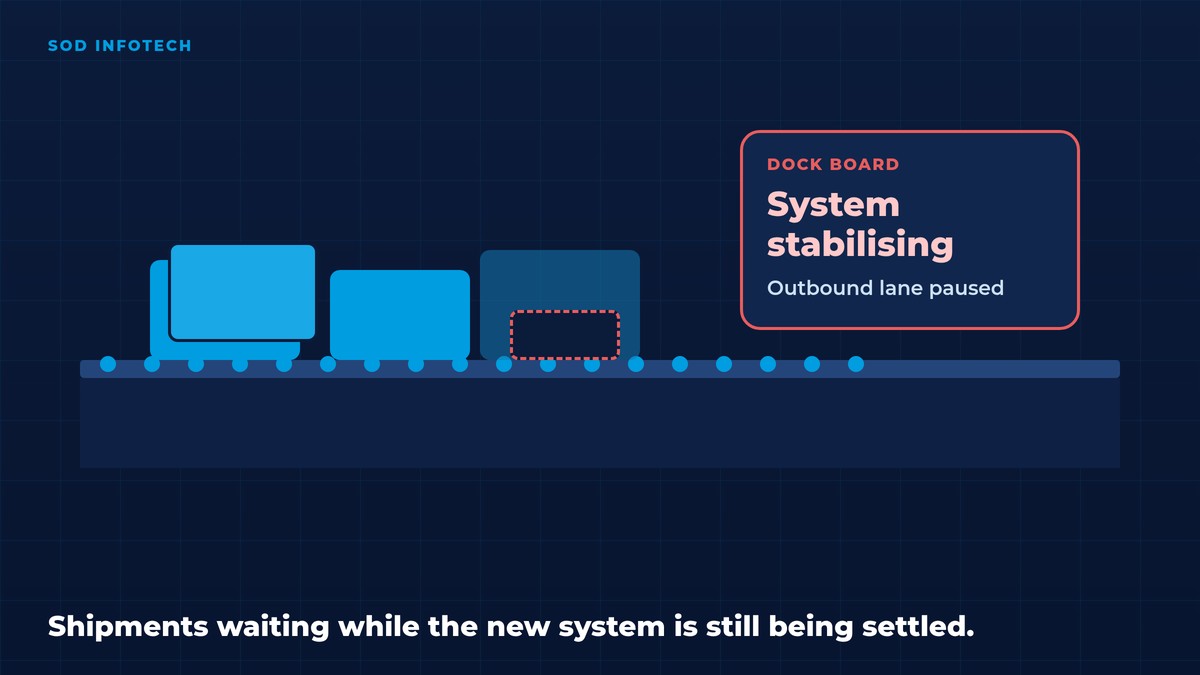
On 8 July 2008, Levi Strauss & Co. reported second-quarter results for the period ended 25 May 2008. Net revenues were $936 million, down 8 percent from $1,016 million a year earlier. Net income was $1 million, down from $46 million. The company’s own headline named two causes: “Challenging Economy and ERP Transition Impact Results.”
The earnings release, filed with the US Securities and Exchange Commission as Exhibit 99.1, did not blame the new system for the entire decline. It said the fall in the Americas was “largely attributable” to a mix of things: a difficult US economy, shipping issues related to the transition of the US business to a new enterprise resource planning system, weaker sales of Dockers, and early shipments in the first quarter ahead of the second-quarter US ERP implementation. Americas net revenues were down 19 percent. The company said that region’s results “primarily reflect the challenges related to the implementation of the ERP system in the United States and the impact of the weak U.S. economy.”
Selling, general and administrative costs also rose. After currency, the company said the rest of the increase reflected “substantial costs related to the ERP stabilization efforts in the United States” and its global retail expansion. In other words, go-live was not the end of the work. Stabilising the new system was still costing money, and shipments were still being affected, in the same quarter.
The retail environment in the United States remained challenging. In addition, our transition to a new enterprise resource planning system in the United States negatively affected our results.
John Anderson, President and Chief Executive Officer, Levi Strauss & Co., 8 July 2008
Takeaway: Go-live is the start of stabilisation, not the end of the project. Plan for a period when shipments, orders and costs may still wobble, and do not schedule a cutover as if the new system will be quiet from day one.
National Grid’s payroll cutover that went ahead in a storm
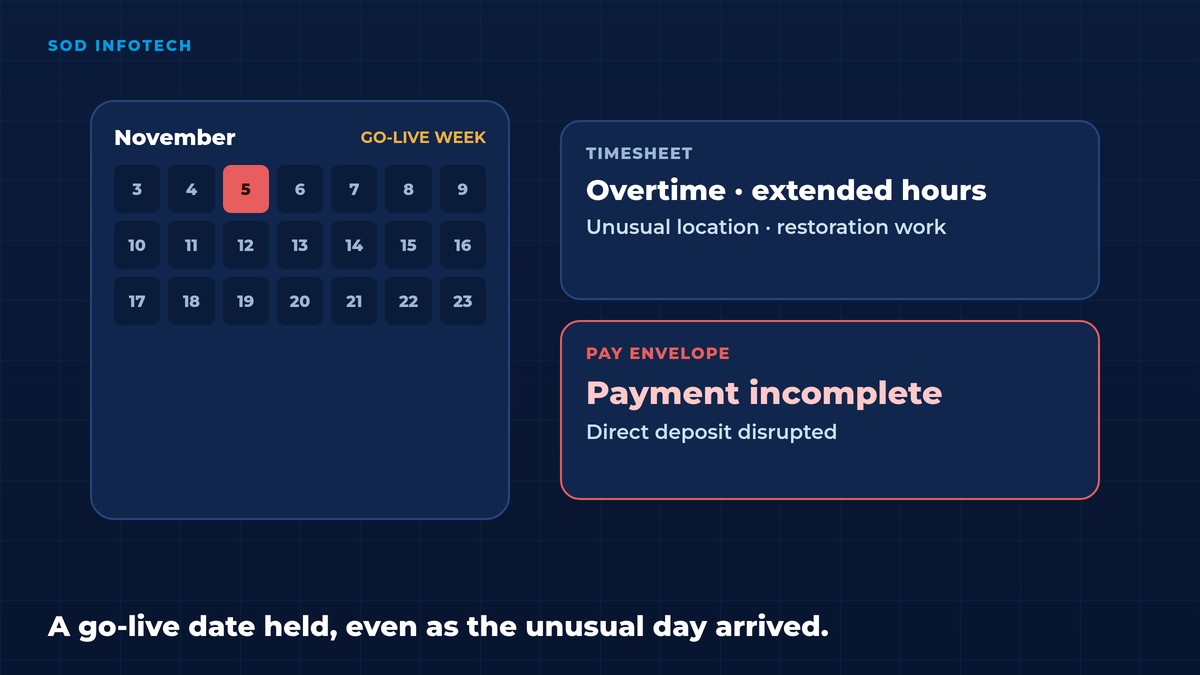
National Grid, the electric and gas utility, had scheduled a company-wide conversion of its time-keeping and payroll systems to go live on 5 November 2012. Hurricane Sandy struck the US East Coast at the end of October. According to the New York Attorney General, the company did not delay.
“Despite the forecasts of a hurricane headed for the East Coast, National Grid failed to delay this company-wide computer conversion,” the Attorney General’s office said in a 26 September 2013 press release announcing a settlement. After the storm, staff worked greatly expanded hours. Many were underpaid or not paid at all. Direct deposits were disrupted. In some cases, established payroll deductions did not run, and employees defaulted on child-support garnishments and other legal obligations.
More than 6,500 hourly employees in New York State did not receive their full pay on time. Over 19 weeks, there were approximately 32,000 incidents in which employees were underpaid and given inaccurate wage statements. The Attorney General found that for more than a month after the disruption, the staffing assigned to fix the system remained insufficient. The company attributed the payment problems to “computer glitches.” Under the settlement, National Grid agreed to pay another $750 to every hourly employee who had worked between 1 November 2012 and 31 March 2013 — more than $4.8 million in additional payments to 6,500 workers — on top of wages that had already largely been repaid, and to give the Attorney General a written account of the causes, the fixes and the lessons.
Some of the affected employees in this case reported that they were unable to repair their own homes after the storm because of National Grid’s underpayments.
Eric T. Schneiderman, New York Attorney General, 26 September 2013
Takeaway: A go-live date is not more important than the conditions on that date. If the unusual day — overtime, new locations, a storm, a peak — is reasonably foreseeable, test for it, and keep the option to delay until the system can survive that day.
Avon’s order-management rollout that stopped after the pilot
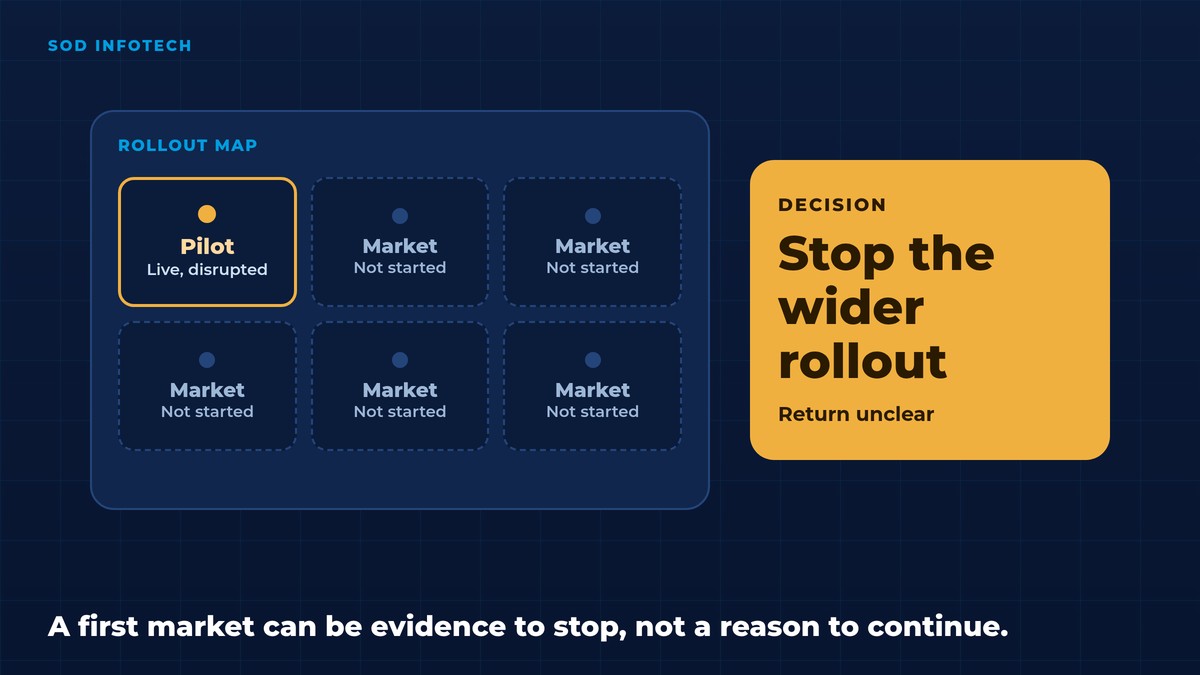
Not every troubled programme is pushed to a finish. On 9 December 2013, Avon Products, Inc. decided to halt further roll-out of its Service Model Transformation project, known as SMT. In an 8-K filed with the SEC two days later, the company described SMT as a global programme begun in 2009 “to improve the Company’s order management system and enable changes to the way Representatives interact with the Company.”
Earlier that year, SMT had been piloted in Canada. The 8-K is plain about what happened next: the pilot caused “significant business disruption in that market, and did not show a clear return on investment.” The company stopped the wider roll-out “in light of the potential risk of further disruption,” and said it would keep using the software only in the pilot market of Canada.
The capitalized software associated with SMT had a carrying value of about $125 million. Because Canada would be the only market still using it, accounting rules required Avon to test that asset against the cash flows of the Canadian business, including the ongoing costs of SMT. Those expected cash flows were not enough to support the carrying value. In its fourth-quarter and full-year 2013 results, released on 13 February 2014, Avon said it had recorded a pre-tax, non-cash impairment charge of $117 million related to the SMT project as a result of that decision.
Stopping was expensive. Continuing, on the company’s own account, looked riskier still.
Takeaway: A real pilot is a decision point, not a ceremony. If a first market is disrupted and the return is unclear, the honest next step may be to stop, even when a large sum is already on the books.
Revlon’s SAP go-live that left a plant short of shipments
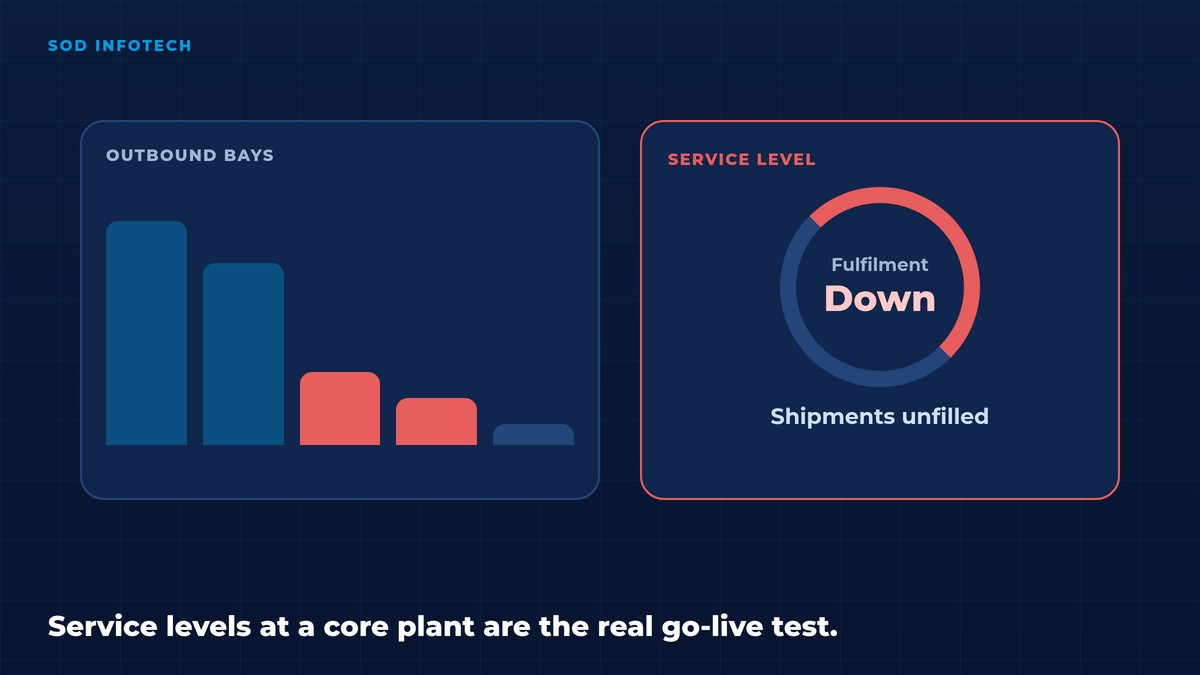
In February 2018, Revlon implemented a new SAP enterprise resource planning system in the United States. In its 2018 annual report, the company said net sales that year were “negatively impacted by service level disruptions” at its Oxford, North Carolina, manufacturing facility as a result of that launch. The disruptions, it said, affected its ability to manufacture certain quantities of finished goods and to fulfil shipments to retail customers in the US and internationally, and led it to incur “substantial costs” in 2018 to restore customer service levels.
When Revlon reported fourth-quarter and full-year 2018 results on 18 March 2019, it put numbers on both effects. As-reported net sales were $2,564.5 million, compared with $2,693.7 million in 2017, a 4.8 percent decrease “due to declines in the Revlon, Fragrances and Portfolio segments, driven in part by approximately $64 million in net sales reductions associated with service level disruptions” at Oxford related to the February implementation. In the same release, the company separately identified $53.6 million of “Oxford SAP disruption-related charges.” It also said it expected to disclose a material weakness in internal control over financial reporting as of year-end 2018, “primarily related to the lack of design and maintenance of effective controls in connection with the previously-disclosed implementation of its enterprise resource planning system in the U.S.”
By 31 December 2018, Revlon said, the Oxford facility was operating at pre-SAP levels, and the company was still refilling inventories across its retail partners, particularly internationally. The cutover had been in February. Getting service back to the previous level took the rest of the year.
Takeaway: A cutover at a core plant has to be rehearsed against real service levels, not only against a technical checklist. Watch shipments, inventories and the financial controls that are supposed to keep working on day one. Recovery can take many months after the date itself has passed.
Lidl’s merchandise system that was stopped mid-rollout
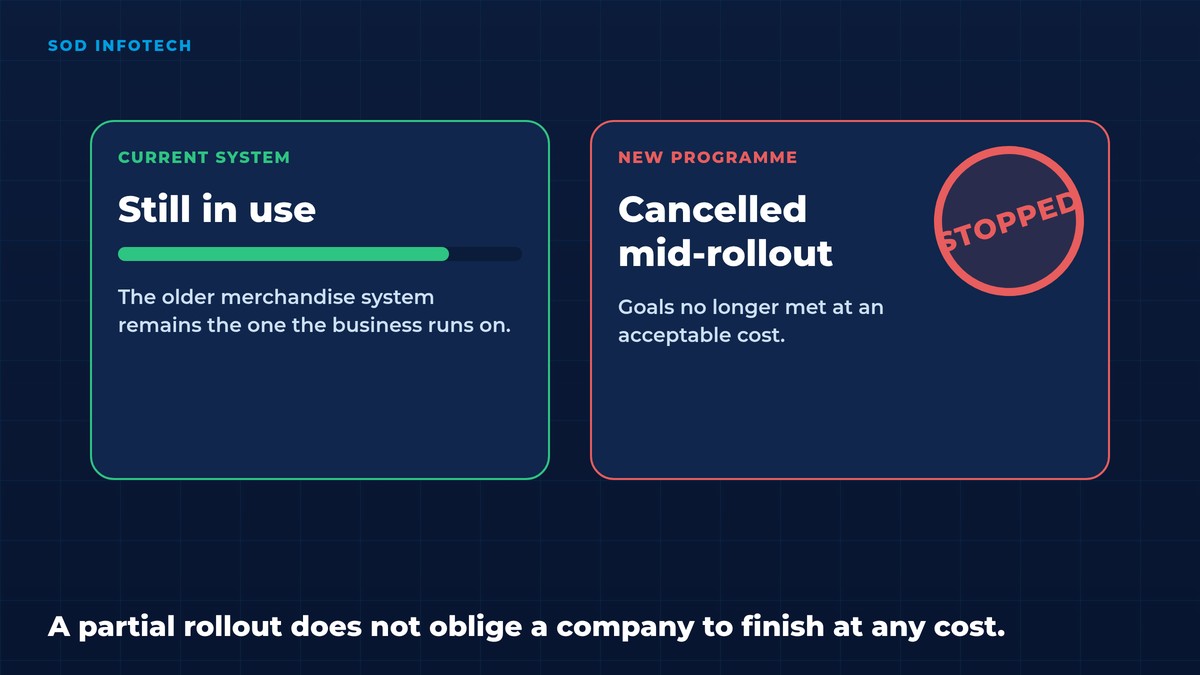
In July 2018, the German newspaper Handelsblatt reported that Lidl had abandoned a years-long programme to replace its merchandise-management systems with a new SAP-based platform. Lidl had called the work “the biggest transformation project in the company’s history,” the paper wrote. The project was known as eLWIS, short for elektronisches Lidl Warenwirtschaftsinformationssystem. Handelsblatt reported that the failed project had cost around €500 million. That figure was an estimate; contemporary reports noted that neither Lidl nor SAP had confirmed it.
According to Computer Weekly, drawing on the same reporting, Lidl had gone live with the new electronic merchandise-management system at its Austrian stores in May 2015 and had planned to roll it out to 10,000 stores and more than 140 logistics hubs. By mid-2018, the wider programme had been dropped. Computer Weekly also reported that a memo, said to be from Lidl’s then head, Jesper Høyer, told staff the strategic goals originally defined for the project could not be achieved without the retailer spending more than it wanted.
The lesson is not that every large ERP programme fails. It is that a partial go-live and a long investment do not, by themselves, oblige a company to finish a design that no longer meets its own goals at a cost it is willing to bear.
Takeaway: If the original goals cannot be met at an acceptable cost, stopping is a decision, not only a failure. Revisit the business case after the first go-live, and be willing to change course before a partial rollout becomes a company-wide problem.
What this means for your business
None of these organisations set out to fail. Each had a date, a vendor and a reason to move. The trouble started when the date, or the sunk cost, became harder to challenge than the evidence that the system was not yet ready — or, in Avon’s and Lidl’s cases, when the evidence finally was used to stop.
A few habits make a go-live much harder to rush:
- Treat the date as a test, not a promise. The cutover should move only when agreed readiness checks have been met, including an explicit option to delay.
- Rehearse the unusual day. Overtime, peak season, a blocked warehouse or a missing specialist will show up at go-live. Test those paths, not only the happy path.
- Watch real work, not just system tickets. Shipments, pay, invoices, inventory and customer-service levels are the score, before and after the switch.
- Believe the pilot. If a first market is disrupted and the return is unclear, do not treat that as a local exception.
- Plan the stabilisation, not only the cutover. Budget time, people and cash for the months when the new system is live and still being settled.
- Keep the business case on the table. After the first go-live, ask again whether the original goals can still be met at an acceptable cost, and be willing to stop.
At SOD Infotech, we help businesses plan and test ERP go-lives so the cutover is a readiness decision, not just a date on the calendar.
Sources
- Levi Strauss — Exhibit 99.1, second-quarter 2008 results (8 Jul 2008), filed with the US SEC
- National Grid — New York Attorney General, "A.G. Schneiderman Announces Nearly $5 Million Settlement With National Grid For Failing To Pay Full Wages To Workers After Hurricane Sandy" (26 Sep 2013)
- Avon — Form 8-K (filed 11 Dec 2013), decision of 9 Dec 2013 to halt further SMT roll-out
- Avon — Exhibit 99.1, fourth-quarter and full-year 2013 results (13 Feb 2014)
- Revlon — Form 10-K for the year ended 31 Dec 2018, discussion of the Oxford SAP launch
- Revlon — Exhibit 99.1, fourth-quarter and full-year 2018 results (18 Mar 2019)
- Lidl — Florian Kolf, "Wie SAP und Lidl Hunderte Millionen Euro versenkt haben," Handelsblatt (27 Jul 2018)
- Lidl — Cliff Saran, "Lidl dumps €500m SAP project," Computer Weekly (16 Aug 2018)